Saturday, 1 November 2014

Day 164: Jodhpur - A blue or many-coloured city?

Anyone know why Jodhpur is called the "Blue City"?
Another day.  Another fortress.  Another palace.  Our Rajastan palace count has now reached four, as has our fortress count, and we have given up counting the temples.  Not that Mehrangarh is just another fort.  Unlike Chittorgarh and Kumbalgarh it sprouts from a single rock bastion above the blue city of Jodhpur, instead of enclosing a sprawling mass of hillside.  It might almost be an organic extension of the sheer rock face.  Impressive.

The palace inside is in great condition and houses collections of embroidered tents (for Maharajas on tour, albeit without their feet in the clouds), palanquins, elephant howdahs, beautiful paintings, gilded weapons - whatever floats your boat.  And to explain it, there's an audio guide narrated by the Marwars who turn out to be considerably less full of themselves then their Mewar cousins in Udaipur and make for far more pleasant listening (they tell you about what you can see in the palace, not just about how awesome they are).  To cap it all, they have even got the hang of funnelling tourists through such a juicy-looking gift shop as they leave the building that they could almost give the retail teams at the RA or the British Museum a run for their money.  Yes, Mehrangarh Fort has got this tourism thing sorted alright, far better than any other attraction we have seen in Rajastan.

A palace guard
After lunch at the fort we walked through some of the bazaars on our way back to our quirky homestay at Juna Mahal.  The street scene was a blur: pink saris, hooting horns, red and gold saris, motorbikes jostling with auto-rickshaws, a handcart stacked with sweets, a row of stalls selling nothing but woven baskets, spice stalls, silver stalls, heat, cool patches of shade, heat, your face almost pressed against a cow's bum, hooting horns, the smell of cumin, the smell of urine, yellow saris, a hard cart piled with fruit, two cows scavenging from a rubbish heap, white trousers with white shirts, orange saris, hooting horns, hooting horns ...

Back at Juna Mahal, we sat on the roof terrace overlooking the blue city.  As evening fell, two mosques duelled over the loudest call-to-prayer, one trailing the other by half a phrase, like slow-motion tinitus.  They even drowned out the hooting horns in the streets below.

Jodhpur is a very real city: not a tourist trap or a hallucination-on-a-lake, like Udaipur.  It's rough at the edges and bustling and smelly and beautiful; both exciting and hard work.  Tomorrow life may get a little easier as we return to tourist-ville in Pushkar.

Jodphur: it's actually multi-coloured!
Mehrangarh from the approach road 
The royal throne at Mehrangarh
Mehrangarh details 
Detail from one of the sets of miniatures on display at Mehrangarh 
Blue Jodhpur
One of the many swallows nesting in the rood at the Mehrangarh Fort
The Fort from our guesthouse (Juna Mahal)
Jodhpur seen from the heights of the Fort
Comfy stylish accommodation at Juna Mahal

Day 163: Kumbalgarh and Ranakpur - Rajastan is green?

Kumbalgarh Fort
On the journey to Jodhpur it was best to avoid the mistakes of the journey to Udaipur.  Today there would be no begging for a detour to a fortress; the side-trip to the Kumbalgarh fort had been written into the itinerary from the very beginning.

Shortly after leaving Udaipur we slipped onto back roads, with all the lurching, pothold-skirting, cow-avoidance, horn-beeping, people-dodging and so forth that this involves.  The land rose before us and green ridges strode away to the horizon.  Green ridges in Rajastan?  I clearly have the sand-blown Rajastan of Jaisalmer firmly in my mind, not the Rajastan of Udaipur and Kumbalgarh in the days immediately following the monsoon.  This Rajastan is green and almost mountainous.  Crops stretch up towards the sun; cattle circle with the mill wheel shackled behind them; lone bicycles weave between ditches.  A rural scene.

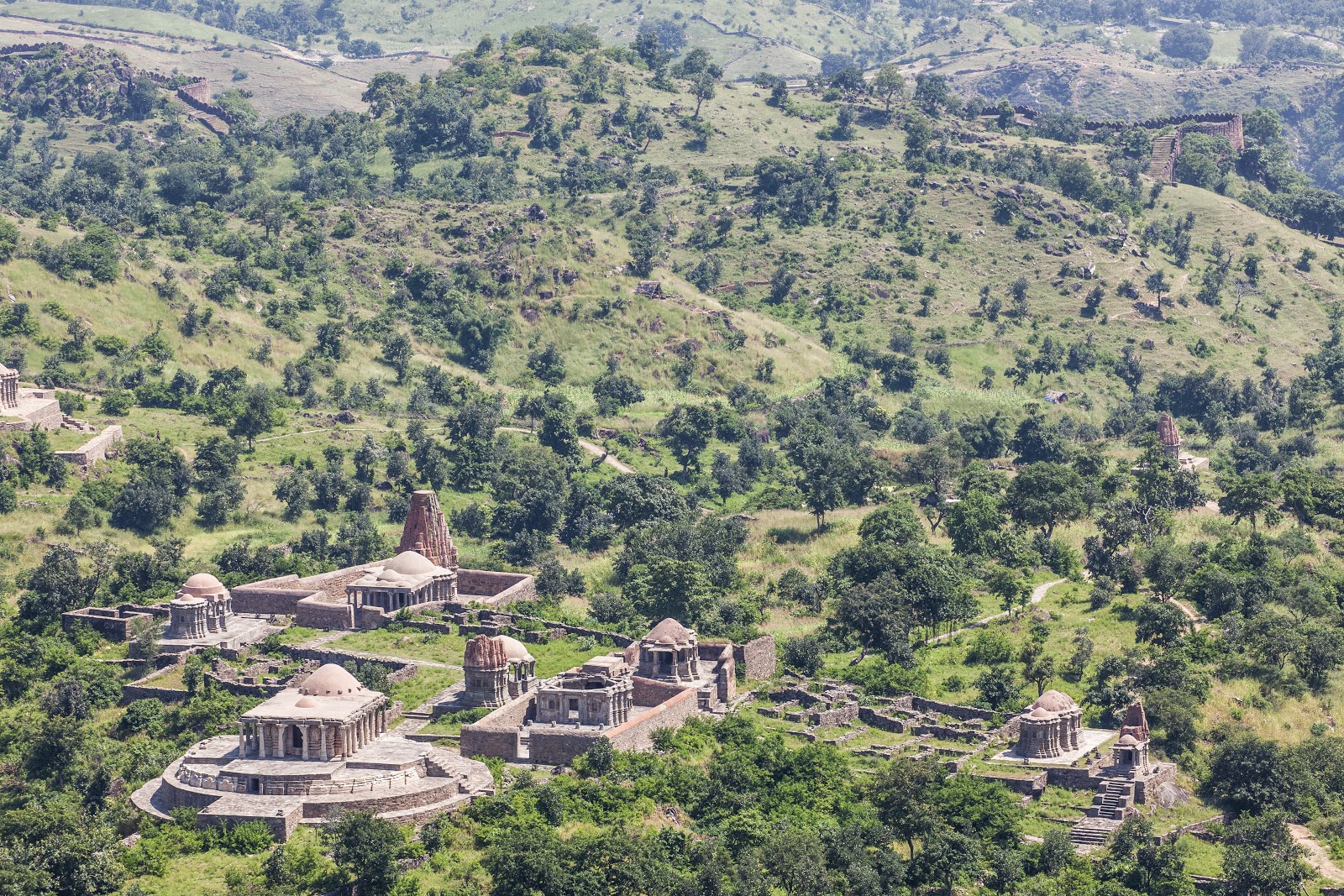
After we had driven for a couple of hours, and Guy had turned faintly green, we arrived at Kumbalgarh - the fortress that has never been sacked.  Its position is so lofty that this comes as no surprise, even if you don't know that the fort was the childhood home of our unbeatable friend, Maharana Pratap Singh.  The temples within the walls lacked the fine detail of those at Chittorgarh but the fort's jaunty position, high in the hills, is unbeatable.  We strolled along the ramparts with a giddy drop below us and looked across wooded slopes to column-ed and sculpted edifices scattered liberally in the wide area between the protective walls.

The statue of a cobra in one of
Kumbalgarh's temples
Another nauseating ride down country roads brought us back to Ranakpur to see the Jain temples.  Things didn't get off to a good start when Guy was short-changed for his entry ticket, then handed tickets for only one person when he'd paid for two, then immediately met some other tourists who told us they'd just been short-changed.  Hmm, there's a pattern here.  Meanwhile our audio guide spelled out the five key principles of Jainism, one of which is that you must not steal.  I think they should employ some new ticket sellers if they want to show this principle in action.

This hiccough aside, the temple itself was beautiful - a thicket of carven pillars and domed ceilings with views to all sides, as the temple was not completely enclosed.  Highly recommended.

By now, the shadows were lengthening and it was time for our hard-working cameras to rest.   The day ended as it had begun; driving towards a fortress.  Tomorrow we visit the fort in the blue city of Jodhpur.  After that, I think we'll be forted-out for a while.

Another temple complex within the Kumbalgarh fort viewed from the palace.
The site is vast: note the walls snaking away in the distance.
Monsoon rains had recently ensured the verdancy of the crops within the boundaries of the fort
Temple complex at Kumbalgarh
The palace at Kumbalgarh
Depiction of an Ox (Kumbalgarh) 
Hercule Poirot meets a Jain monk at Ranakpur
A depiction of Marudevi riding an elephant at Ranakpur
Ceiling detail, Ranakpur

Day 162: Udaipur - Visiting the Mewars

The gigantic city palace in Udaipur
The Mewars are certainly fond of themselves.  Every trend of art, music, and architecture in the city palace of Udaipur is entirely due to the greatness of the ruler who installed it.  Fact.  Broader social or cultural trends don't come into it, nor influences (domestic and foreign), or any other source of progress in the arts.  Most of the plaques in the city palace museum, our first port of call for the morning, spoke entirely of what x, y or z member of the Mewar dynasty achieved, usually accompanied by a smug portrait of said leader, with varying degrees of artistic value.

In a world of warring city states, the Mewars' achievements sometimes focused on the battlefields rather than the arts.  Of course, this means they achieved many great victories, never defeats.  When talking about the battle of Haldighati against the Mughals, for example, the exhibition text explained that Maharana Pratap Singh decided to make "a tactical retreat".  Now I'm no expert on Rajastani history and I don't know the details of the battle, but I take the words "tactical retreat" to mean: "he got beat".  Let's call a spade a spade.

One of the more tasteful thrones in the city palace
Whatever I thought of the commentary (and I'm being harsh; there were some more recent exhibits of musical instruments and Hindu gods that were informative and well-presented), the palace was enormous, speckled with courtyards, rooms of glass, thrones, paintings.  Many of the latter featured hunting scenes including tiger hunts aplenty and the occasional elephant fight under the lash of the whip.  One particularly unsavoury painting showed a tiger being hung up by its paw for sport.  Such, presumably, were the pursuits of the elite - British and Mewari alike, no doubt.

Susan enjoying her visit to the city palace
A far more enjoyable prospect was the view over Lake Pichola.  After our visit to the palace we took the ropeway cable car to one of the surrounding hills so we could spend a snap-happy half hour looking at blue water lapsing into the white turrets of the millionaires' Lake Palace Hotel then back into blue water and wooded hillsides again.

Our own hotel was a bit of a treat and had a huge bay window overlooking the lake, so we returned there at beer o' clock in the afternoon to relax in rather more sumptuous surroundings than we are used to.  Then we retraced our steps to the palace for the evening sound and light show.  The building looked its best, with soft lights cutting through the lacey-edged cupolas, while the turrets cut into the dark sky beyond.  At this time of the evening, Udaipur looked as romantic as all the guidebooks say it is.  Alas, the Mewar dynasty did not radiate quite the same soft light!

Did you know that, beyond doubt, the Mewars are the longest serving dynasty in the history of the world?  That "without the glorious history of the Mewars, the history of India would be but a history of slavery"?  That Maharana Pratap Singh was the world's first freedom fighter?  Did you not know these important facts?

The show was by turns informative, distasteful, shocking, interesting, tedious and enjoyable, in a whole range of different orders.  There was quite a lot of wife burning, a very tender treatment of the first English delegates to Udaipur (why be so tender when they were playing divide and rule for all they were worth?), a general disgust for the Mughals (are there any contemporary resonances here when passions run high on India's northern border, I wonder?) and great pride in Udaipur's long-standing independence and Mewari leadership.  There was a lot to be intrigued by, dubious about, and intrigued by again.

The city palace by night, Udaipur
When the lights went out, we took our last walk along the shores of Udaipur's beautiful lake.  It is flanked by a relentless parade of tourist shops selling pashminas, silk scarves, and leather shoes.  The cries of "hello, where are you from?", "please just look, not buy, just look", "hello, hello, (as we walk away the volume and urgency increases) hello, excuse me," were dying down for the night.  (Why are there thousands of shops and only a handful of tourists?)

I stopped to pick up a scarf to cover my head when we visit temples, and a pair of Indian sandals.  Then we returned to eat our final curry in the land of the Mewars.  From our vantage point on the hotel roof, the bridges cut a line across calm waters, the lamps on the palace gradually faded, so did the spices on our tongue.  The air cooled; candles flickered.  It did not seem to matter how highly the rulers of Udaipur regarded themselves after all.

The famed Lake Palace Hotel, Udaipur

Day 161: Chittorgarh - The devil's in the detours

Gaumauk Reservoir, Chittorgarh Fort
We had driven from Delhi to Bundi on a new dual carriageway where progress was rapid.  Admittedly, every so often we had to swerve away from a head-on with a stray cow or a vehicle driving down the wrong side of the road (on a dual carriageway? You have to be joking!).  Nonetheless it was a smooth ride.  So the road to Udaipur took us a little by surprise.  It was winding, potholed, and sometimes shorter on tarmac than William Hague is on hair.  We bounced around and held on tightly to our metaphorical hats.  Could this really be the way to Udaipur?

Apparently not.  Our driver decided that, first, he would take us to see a waterfall in the middle of nowhere.  I had just discovered that the great fortress of Chittorgarh lay only a few kilometres from our day's route, so I was annoyed by the waterfall detour.  If we were going to detour anywhere today, it would be to Chittorgarh.  But when we stumbled out of the car and across some newly-engineered rail tracks (let's hope it isn't time for the Delhi to Mumbai express, eh?) my irritation evaporated in the heat at the same rate as my morning cup of chai.  A wooded gorge fell away before us with a braided waterfall plunging into its depths.  It wasn't Niagara, admittedly, but it was a great deal bigger than Aysgarth Falls, and much more surprising.  This is Rajastan?  I thought the place was supposed to be a desert.

Bhimlat Waterfall near Bundi
Feeling pretty happy with our aquatic sightseeing, we cheerfully put up with a great deal more bouncing before we ended up on the dual carriageway to Udaipur - travelling in the wrong direction.  But no problem.  Apparently it's okay to reverse for a mile or two down a dual carriageway to get to a u-turn.  It's also okay for a shepherd to drive a herd of sheep along one, just so long as everyone remembers that cows have priority.  Got that, Susan and Guy?  It's all okay.  This is how it works.  Get the hang.

Just before lunch, we spotted a sign telling us that Chittorgarh was now only twenty kilometres away.  I have seen pictures of this amazing fortress before but had failed to realise that it lay close to the route of our already-tight Rajastan itinerary.  Still, we couldn't pass within a dozen miles of the place and not visit.  I persuaded our driver to detour and soon we were making our hurried progress around the palace behind the entrance to the fortress.

All routes around Chittorgarh are hurried, unless they last several days.  The place is vast.  Miles of ramparts enclose a gargantuan hillside.  Within, the palace holds rank with a tower and numerous temples, without an inch of stone left uncarved.  The work was sharp and impressive.  Even the bats thought so; they'd decided to colonise the tower in their thousands.  We stooped under their raftered domain with trepidation then escaped into the sunlight, where another shrine overlooked a pool and further ramparts stretched away into the distance beyond.  We could see more temples dotting the hilltop, but we could also see few hours left in the afternoon.  Lunch beckoned.  But not to worry; the ruling dynasty of Chittorgarh later moved to Udaipur so we will be hearing more from them on our travels around Rajastan.

After this detour, we returned to the fast (except when cows are crossing) road to Udaipur, where we arrived in time to see the afternoon sunshine lighting up the city palace.  All we needed to complete the day was a rooftop restaurant with a view across the lake; what a good job we picked a hotel that possesses one.

And so the day ended with chana massala, lights beading on the city palace, shadowy waters, Rajastani rice, happiness, sleep.

Rajastani nomads making good use of the new dual carriageway.
The guy in front was really pissed off at us for stopping the car right in front of his camel caravan!
The city of Chittorgarh as seen from the ramparts of the fort 
The victory tower (full of bats) at Chittorgarh Fort 
Detail of carvings from one of the temples at Chittorgarh
Inside of a temple within Chittorgarh Fort.
The eyes reminded us of Easter Island Moais.
The Lake Pichola Hotel (a bit of luxury in Udaipur).


Days 159 - 160: Bundi - It's only a palace

The palace and lake in Bundi (viewed from the Fort above)
Our guidebook describes Bundi as "a well-preserved old town, crammed with crumbling havelis, picturesque old bazaars and a surprising number of flamboyant step-wells ... one of southern Rajastan's most appealing destinations" so we were surprised when our driver told us that he hasn't visited the place for five years.  "Tourists don't go to Bundi," he said.  "It has a palace, but there are palaces all over Rajastan."  Our trip to Bundi could work out very well (quiet and off-the-beaten track) or very badly (not really worth visiting), we thought.

As it turned out, it wasn't quite true that tourists don't go to Bundi; there were a few.  But it was quiet enough to ease us gently back into the frenzied world of India after two weeks of Sri Lankan calm.

Susan lost in the undergrowth of the Fort
We spent the morning climbing the hill to the fortress which splayed across the hill top.  It was dilapidated but comprehensive, a creature of many tentacles, and we happily followed several of them, including the one leading to Rudyard Kipling's viewpoint.

But by mid-day the heat beat us and we descended to the Maharana's palace whose walls hide behind beautiful blue-and-green murals.  As we entered, a guide of many words, high volume and little grammar joined us.  He pointed out the mural of a Maharaja peeping from a balcony as a woman changed her clothes in the garden below, another of a woman applying make-up, and one of a woman playing with a yo-yo.  "You take photo; you take photo," he insisted.  I was as interested in which murals he chose to point out as in the pictures themselves, although I also loved the colour scheme which seemed very Islamic - interesting given that Bundi claims to be one of the few cities whose palace was never taken by the Mughals.

The ladies quarters in the palace
When we left, our guide asked us which country we came from.  "England," we confessed.  "Ah, England used to rule India."  There was a pause during which we looked suitably shame-faced.  "But England gave us many good things," he added very insistently, in case we felt put down (or in case his tip was now in danger?).  "England gave us railways, it gave us the post office, it gave us telephones.  Do you know that before the English, we didn't have telephones?"  I suspect that before the days of the Raj, English households didn't have telephones either; their introduction probably had as much to do with technological progress as with empire.  Nonetheless, we handed over our tip (which had never been conditional on praising the Brits) and continued on our way.

From the Maharana's quarters we entered the main palace and took photos of the blue town of Bundi spread below.  But we had to move with care; the palace is crumbling fast.  It's a pity that the only employees seem to be the staff selling and checking tickets (with abundant duplication); none clear weeds from the pathways of the overgrown fortress or shore up flaking walls and subsiding balconies.  It would be a pity to come back in a few years and find sections of the outer wall avalanching down the hill.

After our palace visit we retreated to our hotel, which is a grand old building with courtyards and pillars and a roof terrace overlooking the blue bazaars.  Not bad for £4 each per night.

It turns out that the lack of tourists in Bundi worked out fine for us.  Perhaps more of them should visit?

The palace at dusk
Murals in the ladies quarters
Blue Bundi
The dilapidated main palace (the audience chamber is on the right)
Dodging Cows 1
Dodging Cows 2

Tuesday, 23 September 2014

Day 157: Galle - The Dutch East Indies

Baby turtles!!! Put them back Susan.
To Galle.  Before the Brits got their hands on Sri Lanka, it was home to canals, bicycles and men in orange (because we're avoiding national stereotypes completely today) and the symbol of the Dutch East India company still remains on some of the buildings to tell the tale.  I love the idea that they put a cockerel on their emblem because they thought 'Galle' derived from the Latin for 'cockerel' rather than the Singhalese for 'cliff'.  (What?  The locals don't speak Latin?  The savages!)  If only the colonials always got the wrong end of the stick in such a harmless manner.

We wandered around the walls of the Dutch fortress then visited the Dutch church where flagstones record the entombment of a geliefde vrouw or geliefde zoon (beloved wife, beloved son), with apologies to Dutch speakers if Google Translate got that wrong.   Then we started heading north towards Colombo, the port of choice of the British colonials who replaced the Dutch.

Taprobane island (I hope you are reading this Uncle David?)
On the way, we stopped at a beach-side restaurant where you can choose yourself a fish and then have it cooked (a bit like The Hitchhikers' Guide to the Galaxy, only at least the fish does not speak to you and recommend itself as a fillet when you are making your choice).  Guy picked himself a 630g beast and had it brought to the table in style.  It was so beautifully marinated that I quickly dropped my Hitchhikers' Guide analogies and decided to tuck in too.

After lunch, we stopped at a Sri Lankan mask workshop and museum where the masks that intrigued me the most were those depicting eighteen different types of illness.  The green man was clearly about to vomit and the bright red one was suffering a fever, but some others were hard to call.  The accompanying information told us that demons can inflict a range of illnesses, one of the worst being the black devil who brings erotic thoughts to young girls.  This, apparently, is one of the worst type of illness out there.  Cholera and tuberculosis are not such a dreadful fate after all, but erotic thoughts in a young girl?  May the gods have mercy!

English and Dutch influences at Galle
The next stop was a turtle hatchery, purporting to protect turtles by buying their eggs and rearing them for the first five years of their lives before releasing them into the wild.  That way, they don't end up as breakfast for a stray dog.  We were proudly shown the tank of baby turtles then the 'hospital tank', where those whose limbs have been severed by fishing nets live out their lives.  I wasn't convinced though.  Our 'guide' kept urging us to pick up the turtles, no matter what signs of distress they showed, and practically forced us to pose for pictures with the flailing creatures in our hands.  And this really doesn't hurt them?  What if I've just sprayed Deet to keep off the insects (which I have)?  What if I use steroids on my hands for my eczema (which I do)? Is this really about protecting turtles or running a business where the guide who gets the biggest tip is the one who takes a photo of their client kissing a turtle?  Unfortunately, I guess it must work.

From here it was next stop Colombo and the Great Orient Hotel, where the Englishmen in suits have largely been replaced by Chinese businessmen, and the view from the restaurant looks over a container port not a harbour for sail boats, but where time has otherwise stood still.  A man in a suit plays soothing music on a saxophone; the waiter pushes in your chair for you and unfolds your napkin; the cocktail menu doesn't explain what a Pinacolada or a Bloody Mary contains because the guests are experienced enough cocktail-drinkers to know.  It's been a strange couple of weeks staying in 'proper' hotels where there are clean white bedsheets and so much food that you leave some on your plate (because global food supply isn't tight at all, right?) and, sometimes, there's a swimming pool too, instead of backpacker shacks where you drink bad lager and swap cockroach-infestation stories.  It still feels a little surreal though.  Perhaps it's time to hit the road again.  Tomorrow, Delhi.  (I mean, tomorrow, chaos.)  Farewell Colombo!

The interior of the Dutch fort at Galle
Fresh pineapple?
The lighthouse at Galle
The Dutch church in Galle (with added asian flavour!)